Don’t Check Out. Check In.
The One-Minute Pause That Reminds Me I’m Still Human. A quiet morning practice that uses a little technology to protect something much bigger — and why the best changes usually live in the paradox.
The Body
We wake up already halfway out the door of ourselves; Notifications, reels, headlines, inboxes, podcasts paused, world news.
Even the wellness side of the nightstand is humming; a tracker blinking, a diffuser exhaling, an app telling about your sleep debt. We’re surrounded by more tools to fix ourselves than any generation before us.
And yet the quiet ache of disconnection keeps growing.
I used to think the answer was more and better. More protocols, more tracking, more optimization, more disipline. Then I realized a lot of what we call self-care is just checking out by another name, outsourcing attention to something external before we’ve even checked in with what’s already alive inside.
The shift, for me, turned out to be radically ordinary.
One minute.
Before anything else.
Just coming home to myself.
Every morning.
Before I take in the outside world, I start with my inside world
How the Check-In Actually works
The second I realize I’m awake, I do a simple, short yet radical ritual.
It starts with a question: How am I, right now?
Followed by a full minute of just being. Eyes close or soften, a few slow, full breaths, tuning in to any emotion that may present itself. Whatever comes up in the present moment.
No fixing. No scripting a better mood. No mental to-do list.
It’s not meditation (though it sometimes opens the door to it).
It’s not breathwork (though those can follow naturally).
It’s simply the smallest possible act of recognition: interoception — your nervous system remembering it has a home address and that it is free to rest and start the day from a safe and grounded place.
The Paradox We Live In
Here’s where it gets interesting and honest.
I’m not against data. I’m not against technology. I’m not against gentle structure.
The world is rarely either/or. Most real things worth keeping live in the correct amount of tension between opposites.
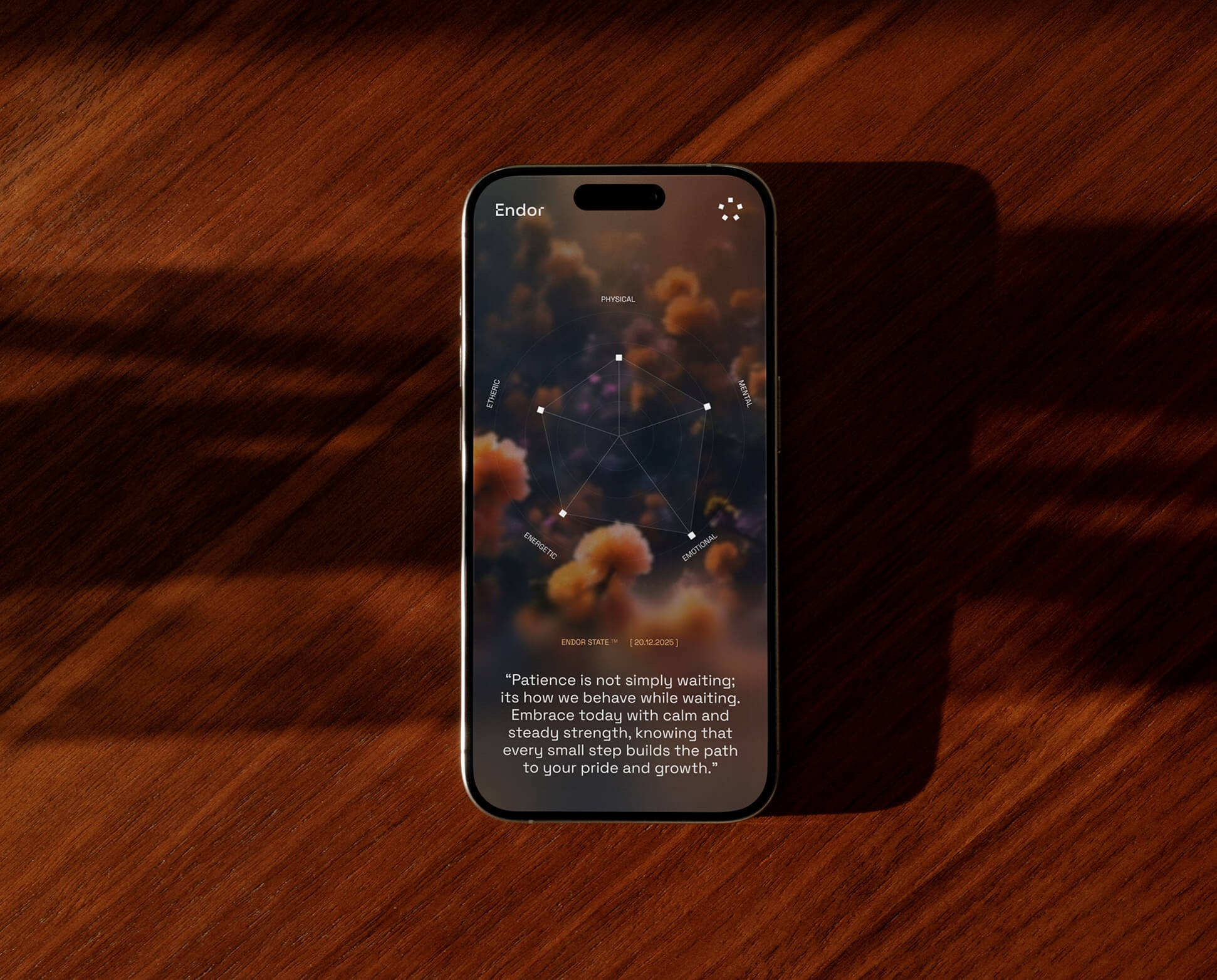
I use an app called Endor because it’s built in exactly that paradox.
It’s human-first tech: no gamified guilt trips, no aggressive streaks that shame you when life happens, no nonsense metrics pretending they can capture a whole inner life.
Instead it offers a quick, optional HRV glance (real time!), a simple visual map of your state (EndorState™), and — if you want — kind suggestions for what might help next. The coaching is the opposite of pushy; it feels more like a friend who’s quietly in your corner, cheering without judgment.
The streak or the daily nudge isn’t there to control you. It’s there to hold space. The same way a good friend might text “thinking of you” or “it will be ok” without expecting an immediate reply. It’s support, not surveillance.
I still trust my gut over any number on a screen.
When I walk into a house I’m thinking of buying, I can study comps and square footage, I do have a minimum spec list, but in the end it’s the inexplicable vibe — the way the light lands, the quiet in the rooms — that decides.
Same with this practice. The data can point, but it’s the felt sense that actually moves me.
Why One Minute Is Enough (and Why Longer Often Isn’t)
Science backs the small-and-slow approach.
BJ Fogg’s habit research at Stanford shows that tiny behaviors, ones so small they barely register as effort, wire in through emotion, not willpower. Anchor it to something you already do (waking up), feel the tiniest spark of “I did it,” and the nervous system starts to say yes. It is a practice of openness, potential and light.
Morning habits stick better. Self-chosen ones succeed more often. And brief interoceptive practices reliably improve emotional regulation, body trust, and attention — no week-long retreat required.
But the deepest reason one minute works?
It leaves room for mystery. It doesn’t pretend to have all the answers. It just opens the door a crack and lets something human step through. If you like, you go on. But that one minute is your space to ground and just be.
An Open-Handed Invitation
Tomorrow morning, if it feels right, try it:
Before the world enters your blank canvas of consciousness, pause for one breath, ask “How am I?”, and listen.
That’s all.
If you want a little scaffolding — a visual reminder of your state, a kind voice that celebrates when you show up, a place to see patterns without judgment — Endor happens to be the tool that made this practice effortless and sticky for me (and it is free). But the practice itself doesn’t belong to any app. It belongs to you.
Some days you’ll feel the difference immediately.
Some days nothing dramatic happens and that’s fine too.
The point isn’t perfection. The point is remembering you’re still here, still human, still worth listening to.
Reconnect. Recharge. Refocus. Realign. Recenter.
Not because you have to, but because it feels like coming home.
What shows up when you pause for that one minute? I’d love to hear, drop a comment below. I read every single one.
//
If this resonates, consider subscribing. More quiet experiments in living like a human (with a little helpful tech when it actually serves) coming soon.
Here’s to small pauses, kind support, and listening inwards <3