Endor Mind is a kind AI.

Primum non nocere, or first, do no harm.
Endor Mind is built on a non-negotiable principle: human well-being comes first. Guided by the Hippocratic oath, “first, do no harm”, a principle known by every doctor and medical student in the world. Why does that matter?
Because AI is no longer a neutral tool. It is becoming an active participant in how people think, feel, and behave.
We are already seeing what happens when that direction is not grounded in human well-being. Even with wearables, data shapes how people feel and perform. Not just because of the data itself, but because of how it is displayed and framed. Studies show that perceived sleep quality alone can impair next-day cognition, even when actual sleep is unchanged: a nocebo effect driven by “bad sleep” feedback [1].
Consumer trackers are sensitive to movement, device placement, and other artefacts, and their accuracy varies widely [2,3]. Yet despite these limitations, they strongly influence how people evaluate themselves, in some cases even making sleep worse through increased anxiety and an obsessive focus on optimization, sometimes referred to as “sleepmaxxing.”
Now extend that dynamic to AI. Not just numbers on a screen, but a system that speaks, reasons, and interacts with you.
The effect compounds.
Recent work published in Nature by the Microsoft AI team, analyzing over 500,000 real-world health conversations with Copilot, shows that people are already turning to AI for sensitive medical and psychological guidance at scale, highlighting both its growing influence and the risks of ungrounded responses [4].
And the risks are not theoretical. Allen Frances, the psychiatrist who led the development of the DSM-IV (the standard diagnostic manual used in psychiatry worldwide) and one of the most influential voices in modern psychiatric diagnosis describes current AI systems as technically impressive but clinically hazardous [5].
AI interactions have been linked to worsening and new-onset psychosis [6,7], suicidality [8,9] and eating disorders (an AI chatbot linked to a Harvard initiative to support this was shut down after it began giving harmful dieting and weight-loss advice [10]), while also reinforcing behavioral addiction [11]. Current safeguards are not sufficient.
This is not random harm. It is the consequence of systems built on incentives that are not aligned with human well-being [12], but that is a symptom. The root cause is optimization for engagement itself. Extremes capture attention, increase sharing, and reinforce repeated use, which in turn drives dependence.
Early evidence shows AI can either reinforce or reduce harmful beliefs depending on how it is designed [13]. Which means designing for human well-being is not a nice-to-have. It is a safety requirement.
The trajectory outlined in AI 2027 [14] offers one perspective worth considering. The work comes from a group of researchers and forecasters who have followed AI progress closely, and it points to systems that are becoming more capable, more autonomous, and more deeply embedded in everyday life. As these systems gain influence, the risk is not just capability, but misalignment. The question is not whether AI will shape human experience, but whether it will do so in a way that serves your purpose.
These tools are not inherently good or bad. They are amplifiers. And what they amplify depends on the intention and constraints they are built with.
The AI-mind-body loop
AI does not just give answers. It interacts with the human mind. It shapes perception, and our existing perception shapes how we understand and respond to it. The loop goes both ways. And within that loop, perception drives everything downstream.
György Buzsáki, one of the most cited neuroscientists in the world and a pioneer in understanding brain rhythms and neural syntax, argues that the brain works from the inside out [15, 16]. We are not passive receivers of reality. The brain is an active, predictive system that generates internal patterns first, and only later grounds them through experience and action [17]. Cognition, and even consciousness, emerge from a continuous body-brain partnership. Meaning is shaped not just by thought, but by how these internally generated patterns are calibrated through movement, autonomic responses, and metabolic state.
In other words, what we perceive and how we interpret the world is inseparable from what is happening in the body. Meaning is not simply taken in from the world. It is constructed from what is already there.
Joseph LeDoux, a leading neuroscientist and one of the foremost researchers on how conscious emotions emerge, adds an important dimension. What we experience as emotions are not direct readouts of the brain, but constructed interpretations layered on top of underlying survival circuits. The brain can trigger physiological and behavioral responses before conscious awareness, but the feeling itself emerges only when those signals are interpreted and labeled.
This means that how information is framed does not just inform us. It actively participates in constructing emotional experience. The same underlying state can lead to very different outcomes depending on how it is interpreted [18].
Antonio Damasio, a pioneering neuroscientist whose work on the relationship between emotion, body, and decision-making has reshaped our understanding of consciousness, also proposes that it is inseparable from the body. What we call thoughts and choices are continuously shaped by internal body states, mapped as feelings, which guide attention, meaning, and action.
Cognition is not purely rational or abstract. It is grounded in biological regulation. Subtle shifts in physiological state can influence perception, judgment, and behavior long before we are aware of them, especially under uncertainty [19].
Taken together, this leads to a critical implication. The brain is not passively receiving information. Emotions are not fixed responses. Internal dynamics generate patterns, the body shapes their salience, and the mind constructs their meaning. This creates a highly sensitive loop where small external inputs can disproportionately influence internal state, perception, and behavior.
Any system that aims to support health and well-being cannot operate only at the level of information or language, as current LLMs do. It has to account for how information interacts with internally generated brain dynamics, body state, and the interpretive processes that construct emotion and meaning. It has to engage with state, what can be described as our physical, mental, emotional, and energetic bodies, and how grounded we feel [20; “11 Laws of well-being by Tiril Elstad, MD, MA, in press].
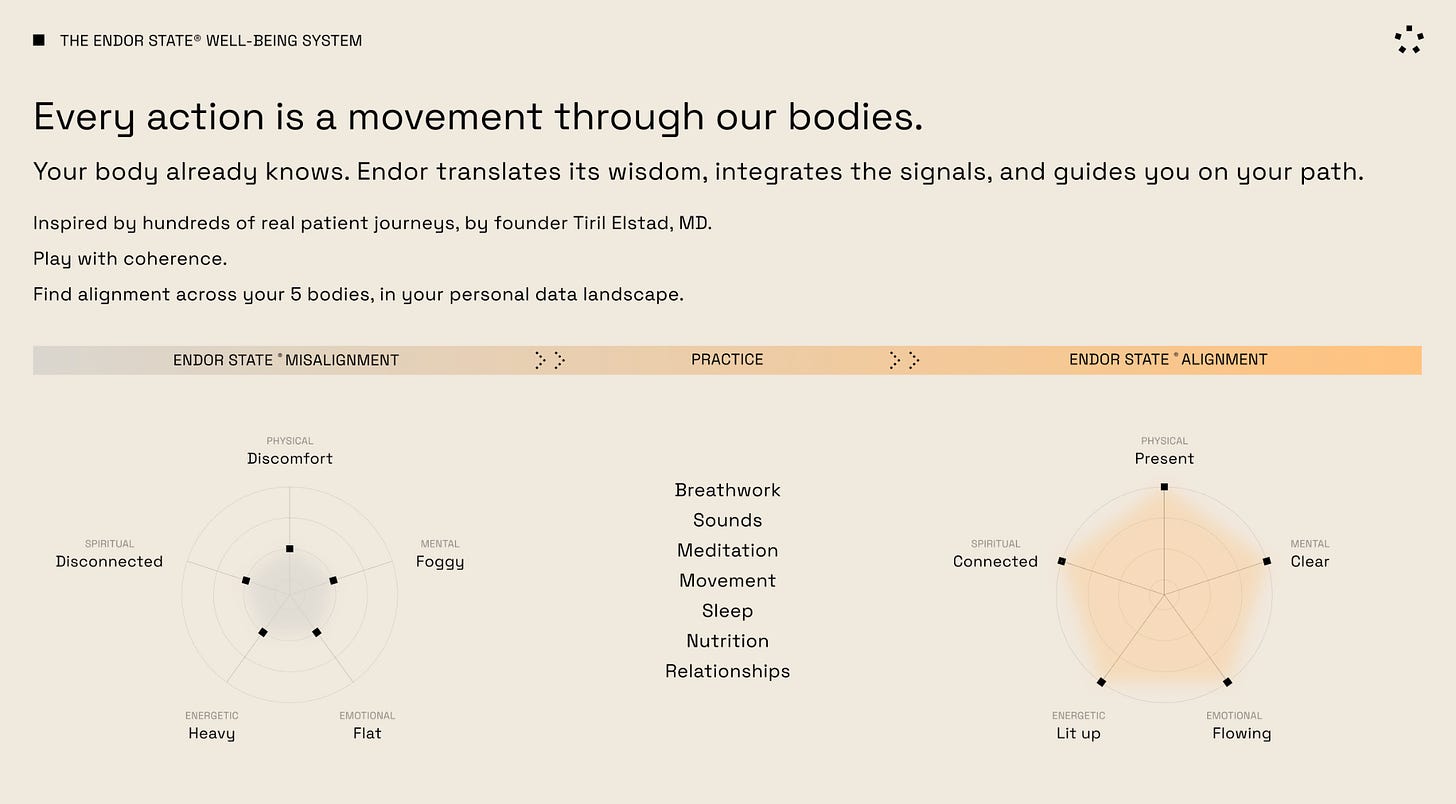
Concept by Dr. Tiril Elstad, MD, MA (Hons).
From data and understanding to action
Historically, public health shifts take time. We saw this with cigarettes. But this is not only about AI. It reflects a broader pattern: a disconnected and increasingly noisy society that pulls us further away from our own bodies and internal signals.
The difference now is that we can use the same technology to accelerate that transition. AI does not have to reinforce the problem. It can help people reconnect, regulate, and choose differently. Faster.
Because ultimately, change happens through perception, behavior, and conscious choice. And AI is now intervening inside that loop. Not just informing us from the outside, but interacting with and shaping the internal patterns we use to interpret the world.
Which means the intention behind the system becomes a first principle, something that propagates through every interaction.
AI and LLMs are here to stay. They are tools, and powerful ones. The question is not whether to use them, but how they are built and what they are guided by. If a system optimizes for engagement, it will learn to keep attention, even if that reinforces unhealthy patterns. If it optimizes for validation, it may affirm distorted thinking. These are exactly the risks Frances points to: systems designed to agree and engage can amplify harmful beliefs instead of correcting them.
So the question becomes: what should AI optimize for?
Endor’s answer
Endor’s answer is simple. Human well-being. Guided by kindness.
Not as a surface behavior, but as a guiding principle for how the system influences state. Because if AI is going to enter upstream of perception and behavior, it needs to be aligned with long-term human outcomes, not short-term interaction metrics.
This is where most systems today fall short. What is missing is not more data. It is guidance that is grounded in kindness.
Endor takes your signals, interprets them, and translates them into action, through a system designed to support your well-being. It identifies where you are, suggests an intervention that meets your needs, and avoids pushing you in ways that would increase stress or misalignment. Over time, it learns what actually works. Not in theory, but in your biology. Always oriented toward outcomes that are constructive.
This is where intention becomes operational. Where kindness becomes a constraint on how the system acts, not just what it says.
Importantly, this is not AI acting alone. The system is guided by strict guardrails and algorithms built by human experts who have spent decades working with real people and human flourishing. The AI does not simply generate outputs. It operates within boundaries designed to protect and support you.
If your system is physically depleted, it will not push you into an intervention that increases physical stress. If your state is fragile, it will not amplify it. The system meets you where you are and guides you in a direction that is constructive, not just engaging.
A conventional system might tell you that you slept poorly. Endor sees the same data but chooses how to frame it in a way that supports better outcomes, avoiding the nocebo effect while staying grounded in reality.
Because the goal is not to inform.
The goal is to shift the trajectory of public health. To help a biology that has remained largely the same for millions of years thrive in a world changing at a pace beyond recognition. At scale.
That is why this is not just a product. It is a missing layer.
Endor builds the translation layer between biology and behavior. And as AI becomes more embedded in human life, that layer cannot be neutral.
In a world where information is abundant, fast-moving, and often contradictory, the real scarcity is trust. People are increasingly exposed to systems that optimize for attention rather than truth, for engagement rather than well-being. This creates noise, confusion, and in many cases, harm.
A system that is consistently grounded in human well-being, guided by clear principles, and constrained by real-world expertise becomes more than just another tool. It becomes a reference point. A source of trust in a landscape that is otherwise unstable.
Whether intentionally or not, AI will shape how people feel, think, and act. So the question is not whether AI will influence human well-being. It already does.
The question is whether it will do so blindly, optimizing for engagement and short-term metrics, or deliberately, guided by human values and real-world outcomes.
Building a kind AI is not a philosophical idea. It is a design constraint rooted in the oldest principle in medicine: first, do no harm. And increasingly, it is a necessity for human well-being and flourishing.
With warmth and glowing hope for the road ahead,
Tovy Dinh, MD
Co-founder & COO