What HRV biofeedback taught me.

It is not the breathing technique. It is the way you do it. On RMSSD, PPG, and hacks for raising your HRV.
Over the past ten years I have guided thousands of sessions in breathwork, meditation and nervous system regulation. And over the past years, increasingly through HRV biofeedback.
One thing has become very clear to me:
The practice is deeply personal.
Each body responds differently. Often, what calms one person may stress another.
This is where HRV biofeedback becomes so interesting, because it gives us a window into the nervous system itself.
How does the body actually respond to different exercises?
HRV biofeedback
Using the HRV biofeedback feature in Endor Global Open Session, I tested different breathing patterns, meditation techniques, sounds and visualisations while observing my body’s real-time response.
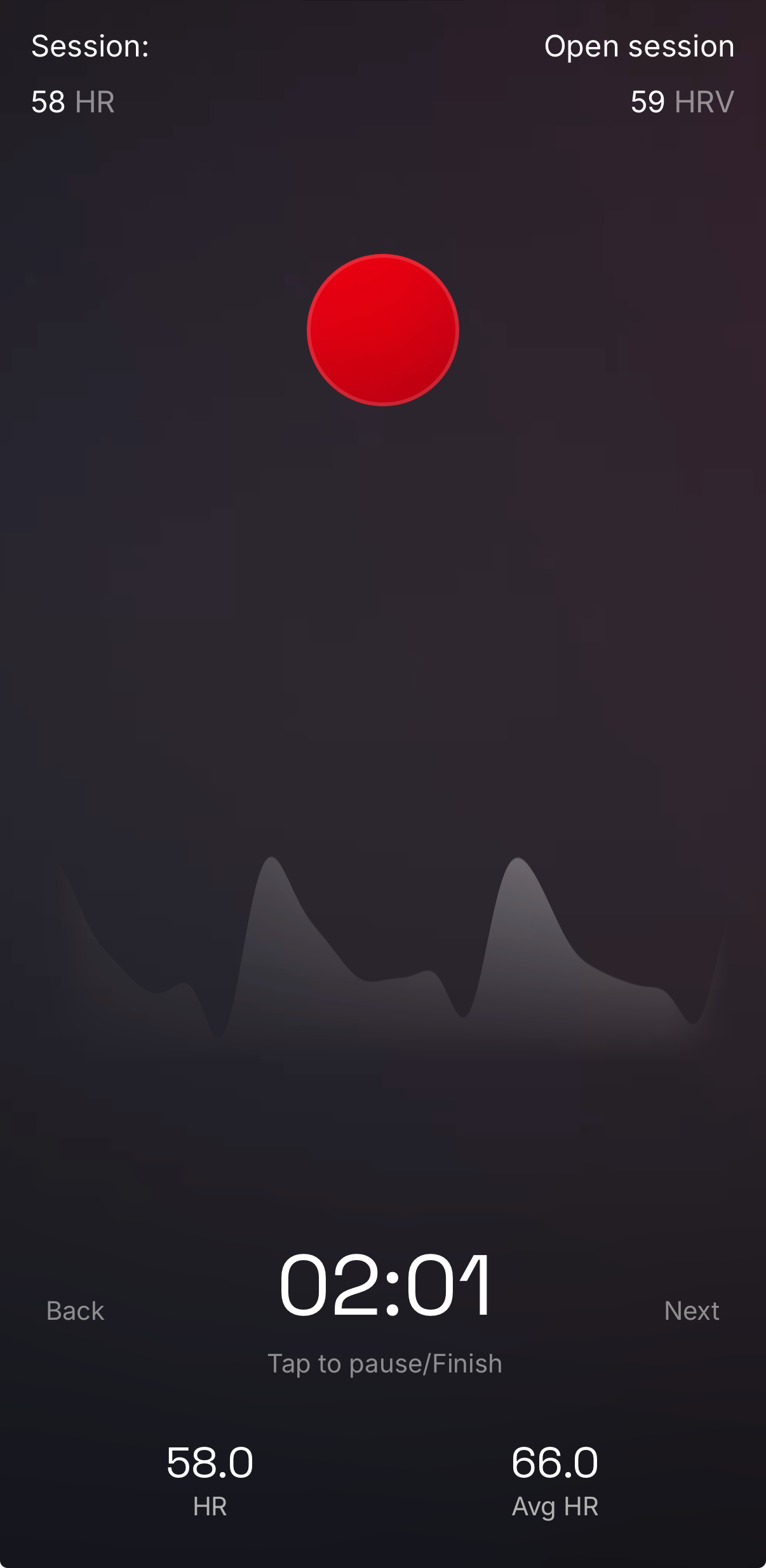
The system shows live Heart Rate (HR), RMSSD-based HRV, and the raw PPG curve itself, allowing transparency into the signal quality and making it possible to observe patterns and irregularities directly.
For those unfamiliar, RMSSD (Root Mean Square of Successive Differences) is one of the most commonly used markers of parasympathetic nervous system activity and vagal tone, and falls under the umbrella term HRV.
In simple terms, it reflects the flexibility and responsiveness of the nervous system. Higher HRV is generally associated with greater adaptability, recovery capacity and resilience. RMSSD is widely used in both research and sports physiology because it is relatively robust for short-term recordings and closely linked to vagal activity.
Research over the past decades has connected higher HRV with improved emotional regulation, stress resilience, cardiovascular health and recovery capacity. Some of the foundational work in this field comes from researchers such as Stephen Porges, Paul Lehrer, Richard Gevirtz and Julian Thayer.
A case study
In my own case, I typically range around 30 RMSSD on days where my nervous system is clearly under higher stress load, fatigued or dysregulated, and up toward 70-80 RMSSD on days where the body enters a deeper parasympathetic state. Of course this varies greatly between individuals, age groups and physiology.
This morning I started around the low-mid 40s as baseline. During some of the practices, especially the softer visualisation-based approaches, I saw sustained periods rising into the 70s. The strongest peaks approached around 80 RMSSD.
For my body this morning, the practices producing the highest RMSSD values were not the ones with the most structure or control, but the ones with the least effort.
It is personal
What brings my body into regulation may not bring yours into regulation. And often it is less about what you do, and more about how you do it.
It is pressure.
Effort.
Attention.
Safety.
Control.
Emotion.
State.
Trust.
Two people can perform the exact same breathing protocol and have completely different physiological responses.
Even the same person may respond differently depending on the day.
If you are anxious, fragmented and cognitively overloaded, your body may need grounding, rhythm and focus to bring attention out of the mind and back into the body and present moment. Sensing practices. Gentle movement. Humming. Mantra meditation. Weighted blankets. Slow rhythm.
If you are exhausted after years of over-efforting and overwhelm, the nervous system may respond better to softness, surrender and less doing. Meditation. Sound healing. Lying in nature. Resting without trying to optimise anything. Opening up to receiving instead of constantly managing.
If you are sick, your physiology may need something entirely different than when you are healthy and energized.
Even mornings and evenings often require different approaches. In the evening many nervous systems respond well to slightly active unwinding such as soft yoga, reading or gentle movement before settling fully into rest.
This is why I believe protocols and recipes are excellent starting points, but not the final answer.
The inhale-to-exhale ratio matters.
The breathing pace matters.
The technique matters.
But so does how you do it.
Are you forcing?
Performing?
Trying to “achieve calm”?
Controlling every inhale?
Or are you listening?
So I began experimenting.
Here is the “menu” of exercises that I tested:
Box breathing
4:4 breathing
4:7 breathing with slightly longer exhales
Different breathing frequencies ranging from roughly three to seven breaths per minute
Focused attention meditation
Observing the breath without controlling it
Awareness placed at the tip of the nose
Open awareness meditation
Visualisation techniques
Gentle movement
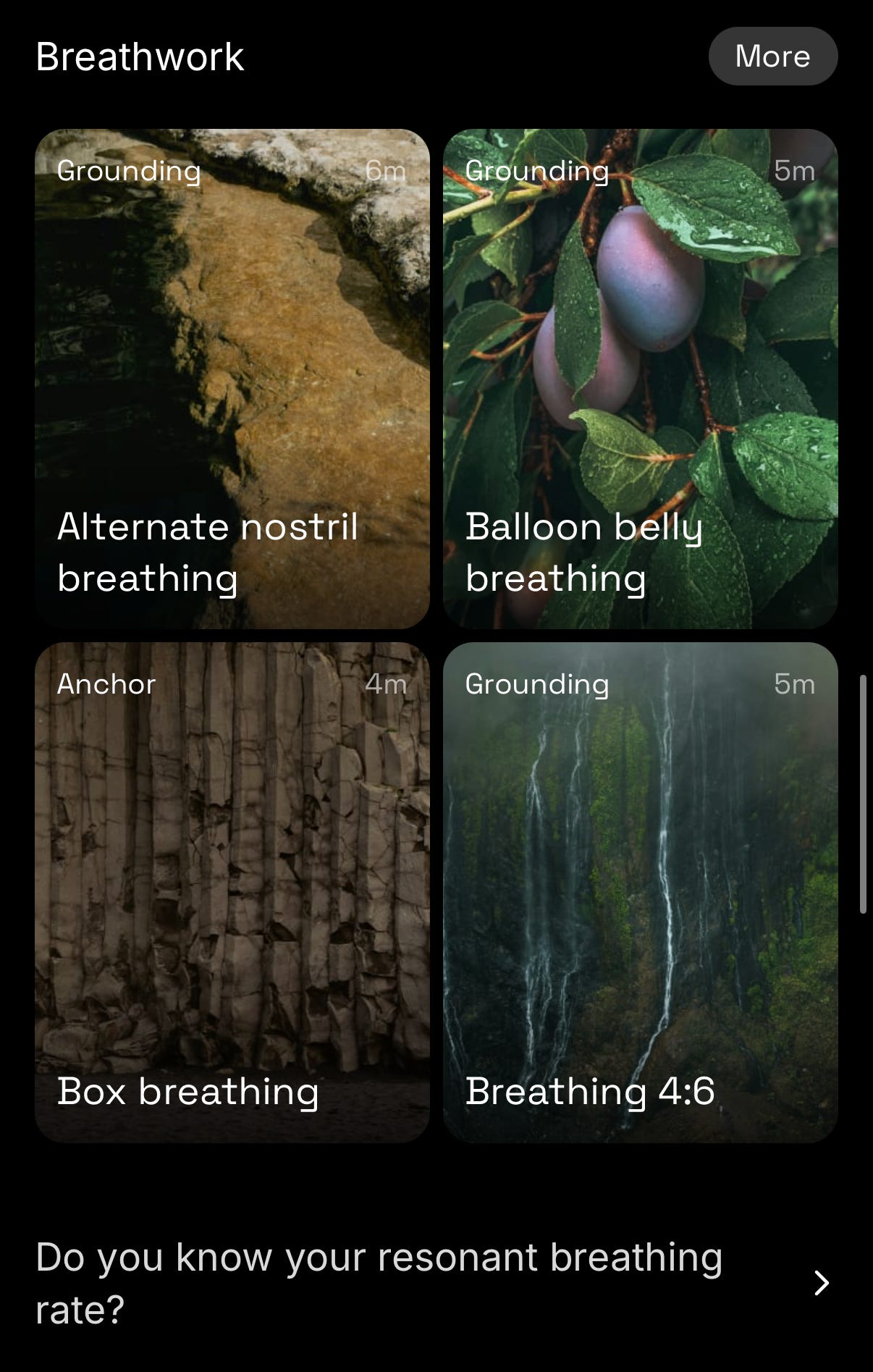
I also experimented with different soundscapes:
Gong
Birdsong
Waves
Running water
Gentle piano
Tailored relaxation soundtracks
One of the most interesting observations was that, for me - this morning, the methods requiring the least effort appeared to create the strongest physiological shift for me this morning.
My top exercises for higher HRV this morning:
The highest RMSSD response came during a wave-based breath visualisation. Instead of controlling the breath, I imagined myself surfing the natural rhythm of the inhale and exhale, almost like catching a wave rather than forcing one. The breath became softer, slower and more effortless on its own.
A jellyfish visualisation worked similarly well. Imagining expansion and contraction arising naturally through the diaphragm created a feeling of internal softness rather than respiratory control.
The soundtrack “Deep Calm” by Endor also produced a surprisingly strong effect.
Interestingly, traditional box breathing appeared less effective for me in this particular session. Box breathing is extremely valuable and well-supported in many contexts, especially for focus, stabilisation and acute stress regulation. It is used by athletes, military personnel and clinicians worldwide.
But this morning, for my nervous system, it appeared slightly too effortful.
The symmetry and control may have required just enough cognitive engagement that the body did not fully let go into parasympathetic dominance. This aligns with something I increasingly observe clinically:
For some individuals, especially those already operating with high internal control, high performance pressure or chronic vigilance, adding more control to the breath may occasionally create subtle tension rather than relaxation.
In contrast, imagery-based breathing and non-forcing awareness may help bypass that layer entirely.
For some of my clients, the most effective breathing exercise is simply breathing out fully and waiting for the body to naturally take the next inhale on its own. Surrendering completely to the body’s intelligence.
What a relief.
Typically I also observe that people who have been “trying hard” for very long periods often benefit tremendously from practices involving less effort.
Not another optimisation task.
Not another thing to master.
But simply being.
This is one reason sound meditations can work surprisingly well. Sound can gently anchor attention without requiring constant cognitive effort or breath control. Sometimes the nervous system relaxes more when it feels supported rather than managed.
Technology as our companion to check in
The technology now exists for people to begin exploring this directly themselves. Not in a laboratory. Not attached to complicated medical equipment. But simply through the camera on an iPhone.
To me, that is extraordinary.
That we can now observe the nervous system in real time.
Experiment.
Learn.
Train interoception.
See what actually shifts the body toward regulation.
Perhaps this is where biofeedback becomes most beautiful.
Not as another optimisation tool.
Not another score to chase.
But as a bridge back into the body.
A way to reconnect with your own signals, your own rhythms, your own physiology, here, now, in this time and this place.
And maybe the goal is not perfect breathing after all.
Maybe the goal is learning how to listen.
References & Further Reading
Lehrer, P. & Gevirtz, R. “Heart Rate Variability Biofeedback: How and Why Does It Work?”
Thayer, J. F. et al. “Heart Rate Variability and Neurovisceral Integration”
Porges, S. “Polyvagal Theory”
Shaffer, F. & Ginsberg, J. P. “An Overview of Heart Rate Variability Metrics and Norms”
“Determining the Optimal Inhale-to-Exhale Ratio for Resonance Breathing and HRV Biofeedback Training”
Tool: Endor Global (in App store). Giving PPG curve, PPI curve, real time HR, RMSSD (HRV) and coherence.